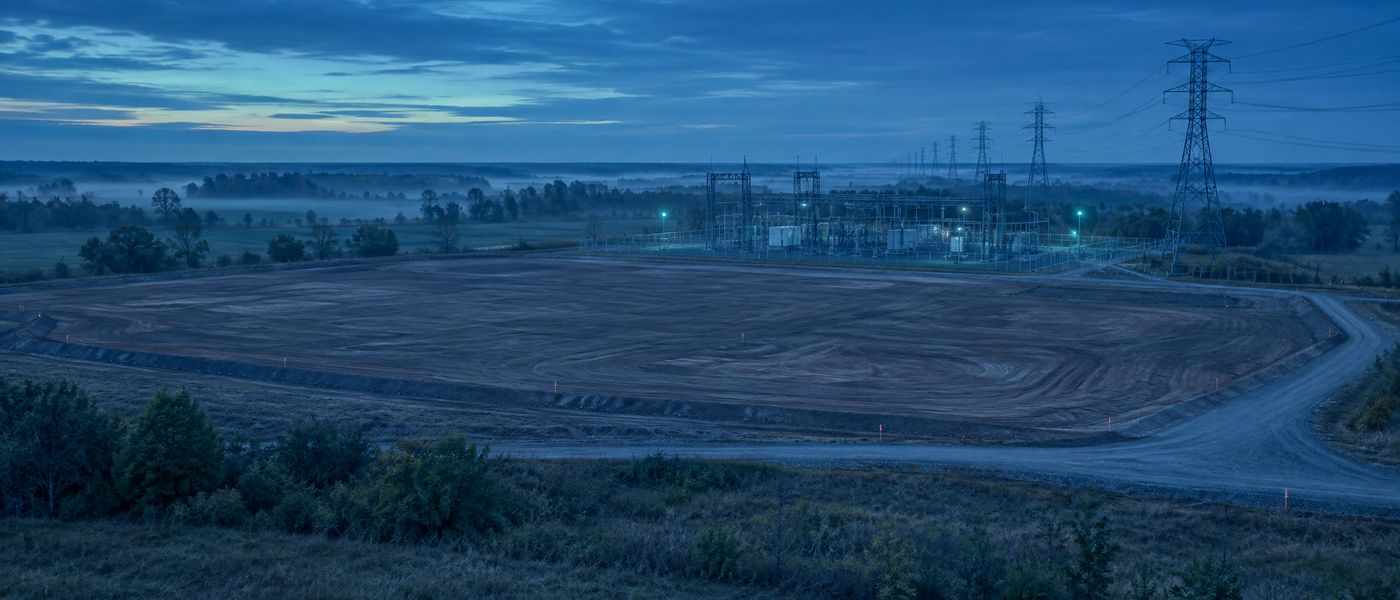
Powered Land: How to Tell Whether a Site Can Actually Deliver the Megawatts
In the AI build-out, land is plentiful and power is not. A large site with a sales brochure is easy to find; a site that can draw a hundred megawatts within the next three years is rare. The difference is rarely visible from the brochure, and it decides whether a data-centre project is built on time, years late or not at all.
This guide sets out what "powered" should mean, how to verify a site's power position, and what to check before you sign an option. The figures quoted are from the United States, where the data is most complete, but the same questions apply in any market, whoever operates the grid.
Why is power, not acreage, the scarce asset?
Demand from data centres has outrun the speed at which grids can respond. Lawrence Berkeley National Laboratory's Queued Up 2026 report found that the median time from requesting a grid connection to signing an interconnection agreement was well over three years in 2025, and more than five years to commercial operation. Those figures cover power plants joining the grid. Large loads such as data centres follow separate utility processes, but they connect to the same congested network.
Equipment is the second constraint. Wood Mackenzie figures reported by Reuters in July 2026 put lead times for generator step-up transformers above 160 weeks in early 2026, and for high-voltage circuit breakers at 125 weeks, against 77 weeks in 2023. A site whose substation has yet to be built inherits those timelines.
What does "powered" actually mean?
Sellers use the word loosely. From strongest to weakest, a site's power position is usually one of the following:
- Energised capacity. A substation on or beside the site already delivering power, with spare capacity contractually committed to the site.
- A signed agreement. An agreement with the utility or transmission owner, such as an electric service agreement, for a stated capacity and energisation date.
- A completed study. The utility has studied the load and identified the upgrades and costs needed to serve it, but nothing is signed.
- An application. A request has been lodged, but no study is complete.
- Proximity. A transmission line or substation nearby, and nothing more.
Only the first two are a power position. The others describe how far a site is from having one. A brochure that says "adjacent to a high-voltage line" is describing the last.
How do you verify a site's power position?
- Get the document, not a summary. The agreement, study or application itself, showing capacity in megawatts, voltage, energisation date and the parties named.
- Confirm it with the utility. Check that the agreement or queue position exists and is in good standing, and whether it can be assigned to a buyer. Many cannot be transferred freely.
- Separate firm from interruptible capacity. Some offers allow the utility to curtail supply when the grid is under stress.
- Check the phasing. "100 MW" may mean 20 MW now and the rest in stages over several years.
- Identify the remaining upgrades. What still has to be built, who pays for it, and the lead times for the equipment it needs.
When does on-site generation make sense?
Where the grid cannot deliver in time, developers increasingly bridge or replace grid supply with on-site generation, such as gas turbines or reciprocating engines, or locate the load beside an existing power plant. That can shorten the timeline, but it brings its own constraints: fuel supply and pipeline capacity, air permits, and the same long lead times for turbines and transformers. The rules are also moving. In the United States, FERC has directed PJM, the largest grid operator, to create new rules for co-located load, and on 18 June 2026 it ordered the regional grid operators under its jurisdiction to justify or revise how large loads connect to the grid and pay for upgrades.
What does site control mean in practice?
Power is worth little without control of the land it serves. Confirm who holds title and that the seller can grant what it is offering, whether an option, a lease or a sale. Check that zoning permits a data centre or industrial load and that no local moratorium applies. Make sure easements and rights of way exist for the grid connection and, where relevant, gas supply, and that water or cooling arrangements are available if the design depends on them.
An option gives a buyer time to complete diligence for a modest fee. It should run long enough to verify the power position, and the buyer should be able to walk away if that position cannot be confirmed.
What should you check before signing an option?
- The power document itself, with capacity, voltage, energisation date and named counterparty.
- The utility's confirmation that it exists, is current and can be assigned.
- Firm or interruptible capacity, and the phasing schedule.
- Remaining upgrades, who pays for them, and equipment lead times.
- Title, zoning, easements and, where needed, water.
- Option terms that let you walk away if the power position is not confirmed.
How Clement Associates helps
We start from the power position and work outwards. On powered land mandates we establish capacity, interconnection status and timeline before anything else, screen sites against the client's compute or industrial load, and structure options and acquisitions to secure a site while diligence completes, so that land, power and compute are planned together.
Clement Associates provides private, relationship-driven access to commodity counterparties and financial infrastructure partners. All introductions are made through established, verified relationships. To open a conversation, connect with us through our website or through an existing introduction.
This article is general information, not financial, legal, tax or investment advice. Take advice from a qualified professional on your own circumstances before acting on it.